Texas 10th
Congressional District

Elect
Bernie Reyna
Tuesday, March 3
If you elect me to Congress, I will treat the House the way it was meant to be: the People’s branch, not a clubhouse for Billionaires. I will stay close to the folks back home, listen first, and recall that I labor for you. Every vote I take will be guided by what lifts up good & honest families, not what enriches speculators & monopolies.I will use the House’s strongest tool—control of taxes & spending—to protect your paycheck and your Liberties. I will push for clear budgets, accurate accounting, and bills that start with the needs of the working & middle class. If an agency, lobby, or president abuses power, I will vote to cut off funding until the problem is fixed. No blank checks. No hidden deals.I will battle against any system that turns our Republic into an Aristocracy. Laws should apply to everyone the same, not just the well connected. I will work to keep government from sliding into corruption, backroom control, or Fascism. The House should be big enough, loud enough, and brave enough to stand up for We the People...every time.
The Restoration Agenda
1). Restore the Public Bank
—Honest Credit to Rebuild America2). Break Healthcare Monopolies
—Public Competition, Not Profit From Sickness3). Nationalize the Electrical Grid
—Power as a Public Utility4). Put Tariffs Back in Congress
—Strategy, Not Chaos5). Hold the Executive Branch Accountable
—No One Is Above the Law6). Ban Stock Trading in Congress
—No More Self-Dealing7). Term Limits
—Rotate Power, Break the Permanent Political Class8). Raise & Index the Minimum Wage
—Pay That Keeps Up With Reality9). Protect Doctors & Women in the Exam Room
—Emergency Care Without Political Interference10). Pass a Bipartisan Equality Act
—Codify Lesbian & Gay Rights11). Aid Dreamers
—Permanent Status for Those Raised as Americans12). Outlaw For-Profit Prisons
—Justice Is Not a Revenue Stream13). Rein In ICE
—No Masks, No Abuses, Full Accountability14). Legalize Cannabis
—Pardon Nonviolent Cases, Tax It, Pay Down Debt15). Sunset Fossil Fuel Subsidies
—Stop Paying Polluters16). Expand & Favor Renewable Energy
—Build the Future Grid17). Register AIPAC Under FARA
—Full Transparency for Foreign Influence18). Cap Military Spending at 2% of GDP
—Defense, Not Empire19). Free Palestine
—End U.S. Weapons and Aid to Israel20). Release the Epstein Files
—Name Names, End Elite Protection


Paid for by Bernie Reyna for Congress • © 2025 All rights reserved.
About

Elect
Bernie Reyna
Tuesday, March 3


Paid for by Bernie Reyna for Congress • © 2025 All rights reserved.

Who I am
Howdy, folks.
This here’s Bernie Reyna, and he’s mighty proud to ride for Texas’ 10th Congressional District. This land is his home, and he aims to serve it straight & true.Bernie is what you might call a rare sight on the trail these days—a Hamiltonian Democrat, one of the last of the Mohicans still standin’ his ground.He’s moderately pro-life, stands firm for the Second Amendment, and believes a man’s freedom ain’t worth much unless he’s willin’ to shoulder his share of the load. To Bernie, that means standin’ guard over women, children, and families, and keepin’ every neighbor clear of the long shadows of hunger, poverty, and desperation.He hangs his hat in COLLEGE STATION, right in the heart of TX-10, where he works as a veterinary professional.Bernie is a Roman Catholic, a family man blessed with five young’uns, and a wife as extraordinary as they come—she keeps their home steady, rooted in faith & purpose.His greatest strengths are loyalty & compassion. Those are the guns he carries into every fight and every challenge, and the same ones he aims to take with him to Washington to stand up for the folks he represents.Bernie Reyna is ridin’ into this race because TX-10 deserves a representative who stands tall for its values—faith, family, hard work, responsibility, and takin’ care of your neighbor.
Elect
Bernie Reyna
Tuesday, March 3
Paid for by Bernie Reyna for Congress • © 2025 All rights reserved.
ECONOMIC RIGHTS
The right to productive employment:Full employment is not just a social aspiration but a macroeconomic stabilizer that maximizes output, reduces welfare costs, and maintains consumer demand. Productive work is the engine of human capital development.
The right to wages sufficient for basic consumption & dignified living:Adequate income supports aggregate demand, prevents negative multiplier effects, and avoids the long run social costs associated with poverty traps.
The right of farmers to fair, sustainable returns:Stable farm income protects food security, prevents destructive boom bust cycles, and maintains rural labor markets essential to national supply chains.
The right of businesses—large & small—to operate in competitive markets free from monopolistic distortion:Competitive market structures promote innovation, reduce rent seeking, and prevent allocative inefficiency caused by concentrated economic power.
The right of families to stable housing:Housing stability is tightly linked to labor mobility, educational outcomes, and macroeconomic resilience. Volatile housing conditions create major negative externalities.
The right to accessible & effective medical care:Healthy workers are more productive; untreated illness imposes large negative externalities and raises long term public expenditure through avoidable chronic conditions.
The right to protection from catastrophic economic shocks—old age, illness, injury, or unemployment:Social insurance systems mitigate downside risk, stabilize consumption, and reduce the volatility that can trigger recessions.
The right to high-quality education:Education is the most powerful form of human capital investment, driving innovation, labor productivity, and long run GDP growth.
What I believe
It is our job now to make a plan and choose a strategy to win a lasting peace and build an American standard of living higher than ever before. But we cannot be satisfied—even if most people are doing well—if a large number of Americans are still hungry, poorly clothed, badly housed, and living without security.Our country began and grew strong because of basic rights that cannot be taken away. These include freedom of speech, freedom of the press, freedom of religion, the right to a trial by jury, and protection from unfair searches and seizures. These rights protect our life and liberty.But as the nation grew and our economy became more industrial, we learned something important: political rights alone are not enough to make life fair for everyone. Real freedom cannot exist without economic security and independence. People who are hungry and unemployed are easily pushed into fear and anger, and that is when dictators can rise.Today, we understand these truths clearly. That is why we have accepted, in a way, a second Bill of Rights—so every person can have a basic level of security and a real chance at prosperity, no matter their job, race, or religion.
Collectively, these rights form the economic foundation of national security and long term prosperity. Implementing them is not simply a moral project but an economically rational strategy for increasing national output, reducing systemic risk, and strengthening social cohesion.America's position in the global economy depends on the degree to which these economic rights are realized domestically. Persistent insecurity at home creates structural weaknesses abroad; no nation can sustain global leadership while tolerating internal economic fragility.Rewritten by
Bernie Reyna
U.S. Army veteran
College Station, Texas
2026 congressional campaignOriginally written by
Franklin D. Roosevelt
State of the Union Address
Tuesday, January 11, 1944.
Elect
Bernie Reyna
Tuesday, March 3
Paid for by Bernie Reyna for Congress • © 2025 All rights reserved.

Howdy, my name is Bernie, and I’m running to serve & protect American workers and senior citizens in the 10th Congressional District of our blessed State of Texas.
Why I'm running for Congress
I’m running because Congress has been captured by a narrow political class—overwhelmingly lawyers, lobbyists, career politicians, and financial speculators—who do not represent the lived reality of ordinary Americans.For decades these idle “representatives” have bled the middle class dry and laid heavy burdens upon the working class—burdens they never feel themselves.Research shows that policymakers from elite professional backgrounds consistently prioritize the interests of donors, corporations, and political insiders over working people. We feel the consequences every single day.
WHO I AM
I am not just another one of these typical politicians perched up high upon a pedestal.No — I am a working family man, and I have spent 22 years in the trenches of the working class, alongside the same people I’m asking to represent: rising early, putting in an honest day’s work, and paying my fair share of taxes.
THE AMERICAN DREAM IS BREAKING DOWN
I am running because the hard facts of our national life tell us something plain: the foundations that once upheld the American Dream have been allowed to crack, and the people who built this country are paying the price.Our quality of life has diminished compared to yesteryear, when the middle class was strong and growing, and the working class was filled with pride and dignity.
THE HOUSEHOLD CRISIS
As a result, most households now operate with almost no financial margin. Millions live paycheck to paycheck with negative cash flow. Utility shutoffs, evictions, and medical delinquencies are rising at rates economists associate with systemic household stress.Families are turning to high-interest credit cards not for discretionary spending, but simply to meet basic consumption—distress financing.Without correction, our country will eventually return to the status of a colony, surrendering its independence piece by piece.
WASHINGTON’S FAILURES
Washington, D.C. doesn’t need another lawyer, judge, lobbyist, or idle speculator. The place is already crawling with battalions of these loafers who have never worked an honest day in their lives.These middlemen will never grasp the true value of American labor or the pride that comes with it, because they have never experienced it.And because they’ve never built anything themselves, they will always shortchange the men and women who do. When the time comes to write laws, workers—the true producers of this country—are the last people they ever think about.
WHAT WASHINGTON NEEDS
What Washington needs right now is workmen—real ones. Men & women who know the feel of an early morning, who rise at daybreak and report with their hands ready, their minds steady, and their purpose fixed on getting something done. This nation runs on people who can produce—not on people who merely talk about producing. And with barely two percent of Congress coming from the working & middle class, it’s no wonder Washington has forgotten what real work looks like.
MY VALUES
What I bring to the table can’t be bought. It’s loyalty—earned by work, proven by conduct.How many politicians have sworn upon holy books to support and defend our Constitution, invoking God, only to become disciples of Judas, betraying their constituents for financial gain?Insider trading and corruption have defiled the once-venerable halls of Congress and turned them into hovels of hypocrites.
MY ETHICAL VOW
I do not own any stocks, nor would I deign to do so.And I make this solemn vow before God and my fellow citizens: I shall not soil my hands with insider trading, nor bow to any lobby that seeks to purchase the counsels of a free nation.I will never take bribes from lobbies—AIPAC or any other—whose lucre is offered to sway the judgment of Congress.Let all people know: my allegiance is fixed upon the honest citizens of this land.
MY PROMISE TO YOU
If you grant me your vote, and Providence allows me to be elected, I pledge to work nights, weekends, and extended hours to personally answer every single one of your questions, comments, or concerns.
THANK YOU
Thank you for your time and attention.Bernie Reyna
U.S. Army Veteran
College Station, Texas
2026 Congressional Campaign
Elect
Bernie Reyna
Tuesday, March 3
Paid for by Bernie Reyna for Congress • © 2025 All rights reserved.
Issues
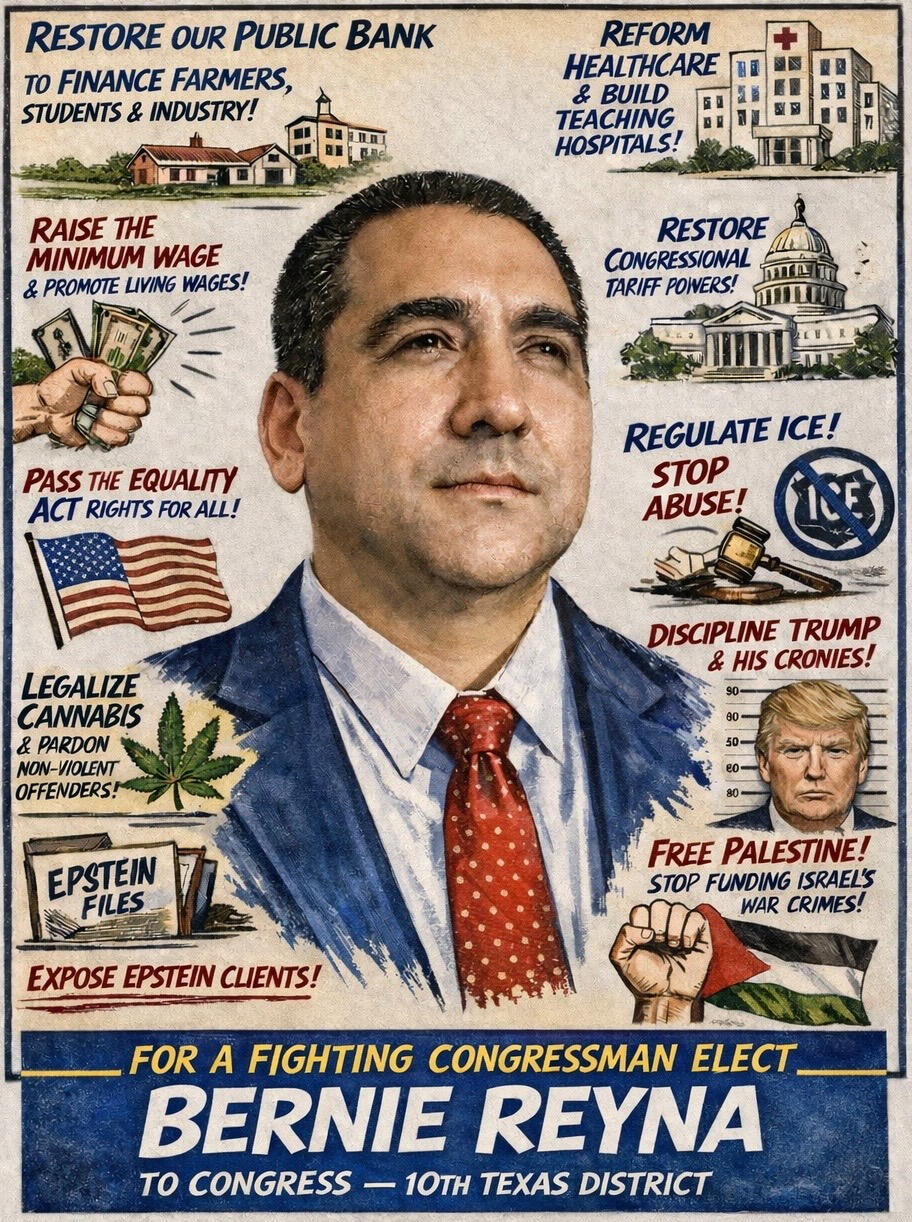
TOP 10 list
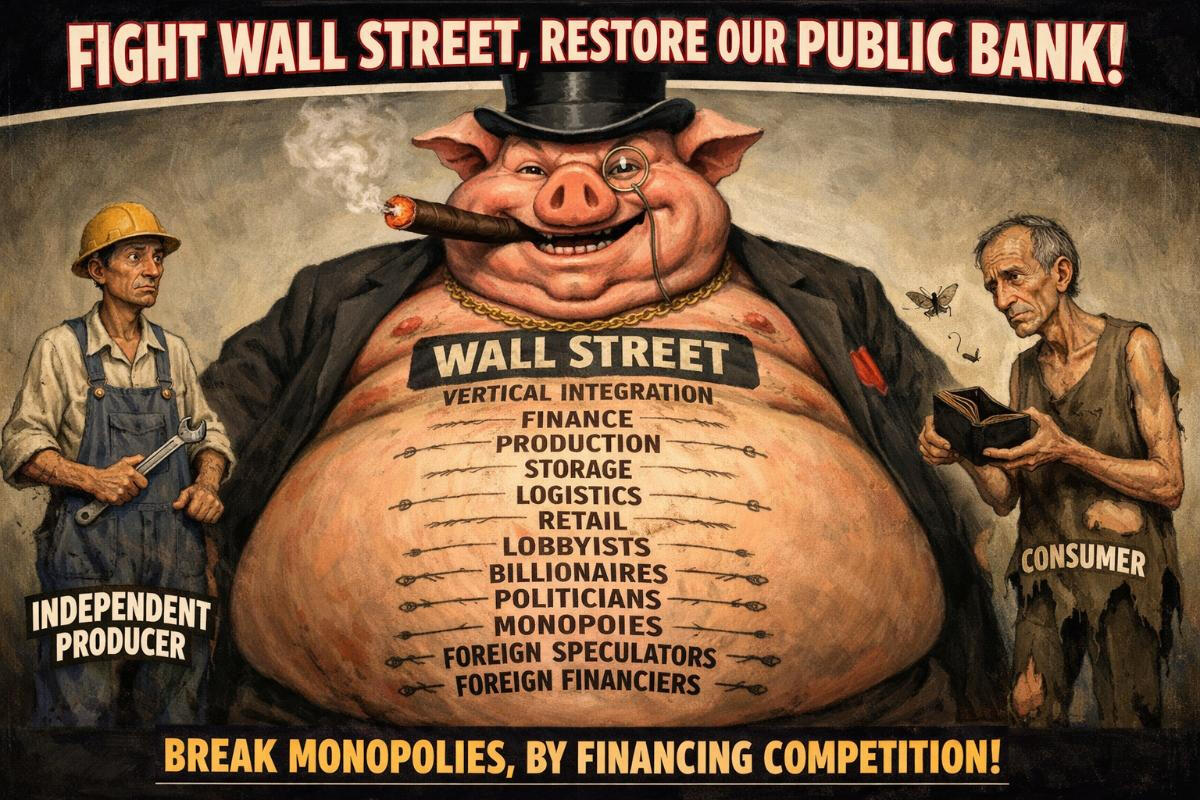
1). Restore our PUBLIC BANK to provide affordable, long-term public credit for farmers, ranchers, students, clinics, and the industries America depends on. By cutting financing costs and expanding real production—food, energy, housing, and manufacturing—we can lower the cost of living, save family farms, and bring strategic jobs back from China. As the bank earns interest and returns profits to the public, those revenues can help pay down the national debt. Public credit helped build our Republic, helped end the Great Depression, and helped power victory in World War II—and it can magnify America once more.2). Reform healthcare. Build new teaching hospitals to create Public Competition in our healthcare system, which is currently dominated by private monopolies. Also, delist health insurance companies from the stock market. It is immoral to make dividends from sick & dying people. Allow interstate competition in the insurance business. Expand Medicare for All as a public option. Competition always generates the most efficient pricing.3). Raise and index the federal minimum wage to roughly $11.50 (national average), and pair it with voluntary living-wage incentives tied to MIT’s Living Wage Calculator—using tax credits and federal contracting preference for employers who meet local living-wage benchmarks. This would stimulate rural communities, reduce turnover, and help working families keep up with local costs.4). Restore tariff power to Congress: Tariffs are taxes. Under the Constitution, revenue measures originate in Congress. Tariffs without strategy are liquidation: you don’t rebuild America by taxing the basic inputs U.S. industry needs. For example, lumber, scrap steel, and copper ore are upstream inputs that feed downstream production—so indiscriminate tariffs raise costs, squeeze margins, and slow output.5). Pass the Equality Act by amending it to reflect bipartisan agreements, codifying Lesbian & Gay rights.6). Regulate ICE! The fabric of our Constitution was never designed to hold such a monstrosity. Currently, it is operating under a de facto GENERAL WARRANT. The 4th & 5th Amendments were enacted to protect ALL PEOPLE from abuse and deprivation of due process. No masks! Body cameras on! Badge numbers visible! Proper training & vetting! End for-profit detention centers! U.S. Marshals oversight!7). Investigate & Discipline the Executive brach for: Abuse of power, Misuse of official authority, Obstruction of justice, Interference with investigations, Obstruction of Congress, Contempt, Dereliction of duty, Gross misconduct, Serious rights violations, Unlawful enforcement patterns.8). Legalize Cannabis in its dried, natural form(Marijuana Cigarettes), and put a federal excise tax on it to pay down the national debt. Pardon all non-violent Marijuana convictions. If Trump can pardon violent insurrectionists, then we can extend that same courtesy to our hippies locked up in jail.9). Release the Epstein files! The Trump administration and House Speaker Mike Johnson are actively protecting the NAMES of the cockroaches who used & abused vulnerable American girls. Shine the Light of truth where that darkness seeks to hide.10). Free Palestine. Halt all funding, aid, and weapons to Israel. Recognize the ICC’s warrant for Netanyahu, and accept the UN Commission’s finding that a genocide is taking place against Palestinians.
Elect
Bernie Reyna
Tuesday, March 3


Paid for by Bernie Reyna for Congress • © 2025 All rights reserved.
Restore our PUBLIC BANK
Elect
Bernie Reyna
Tuesday, March 3


Paid for by Bernie Reyna for Congress • © 2025 All rights reserved.
Cost of Living & Inflation
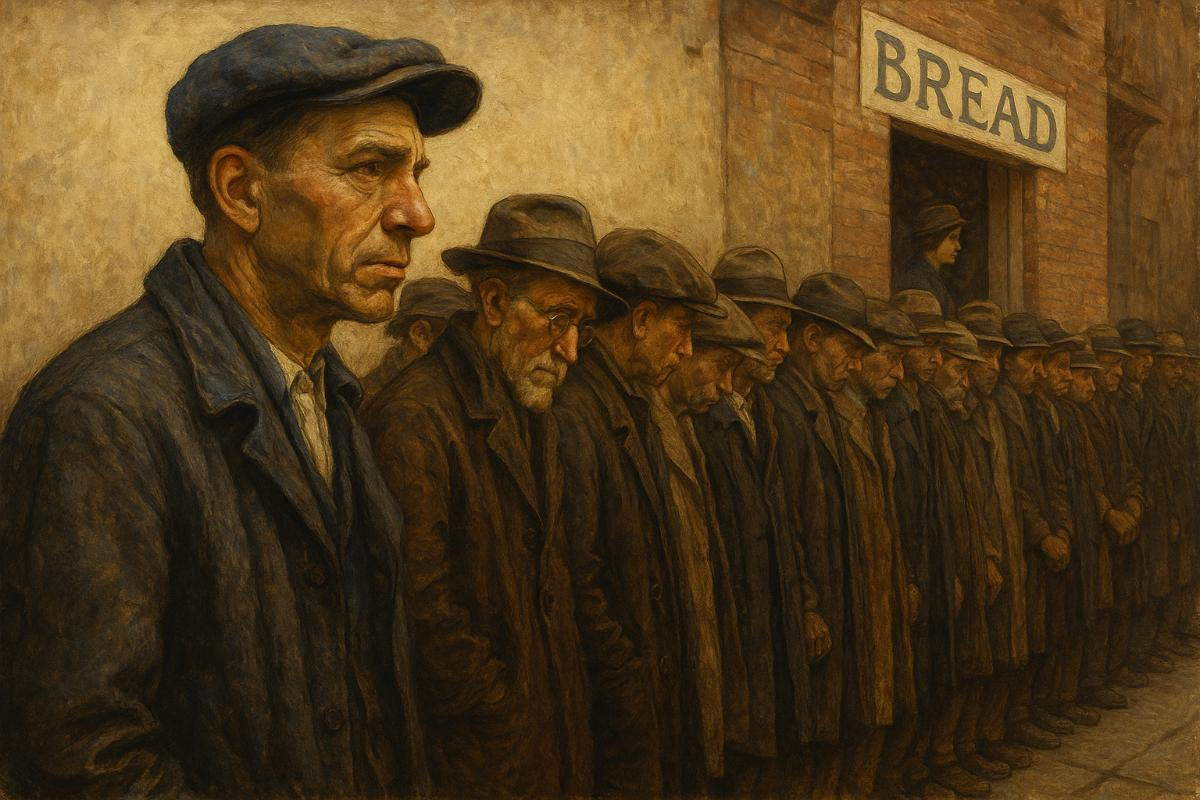
Congress must stop tinkering at the edges and get back to first principles: cool wasteful speculation without strangling real work, and then pour its effort into the only things that ever built a nation—more food, more energy, more homes, more factories, more transport, and more trained workers.If Washington fast tracks production, breaks bottlenecks, cuts out the parasites, restores honest credit, and forces fair dealing in housing, healthcare, and industry, prices will fall, wages will rise, and the American family will stand on solid ground again.The cure is simple: build more, produce more, compete more—and stop letting speculators and monopolists run the country instead of the people who actually make it go.
WHAT CONGRESS CAN DO IN THE NEXT 24 MONTHS
Cool Excess Demand Without Causing a Recession:Congress cannot order the Federal Reserve, but it can shape demand levels through fiscal policy.Target deficit reduction only in overheated sectors (e.g., luxury autos, speculative finance) rather than cutting across the board.Pass countercyclical stabilizer rules (automatic triggers that slow certain tax incentives when inflation is above target).Increase support for productive sectors (infrastructure, energy, food production) so cooling demand doesn’t kill jobs.Impose temporary credit constraints on luxury lending & speculative asset markets through the CFPB & FSOC.Cool demand where it overheats, not where workers live. This avoids recession.
Expand Supply (Especially Food, Energy, Housing)
This is where Congress has the strongest tools.Pass a National Permitting Reform Act to speed up housing, energy, and industrial construction.Restore and expand the DOE Loan Programs Office to finance capacity expansion at 0-2% interest.Create a national industrial credit facility.Fund port, rail, and highway modernization to remove logistics bottlenecks.Provide temporary subsidies for critical inputs: fertilizer, diesel for freight, cold storage electricity, etc.Expand the Workforce Innovation & Opportunity Act to train more workers in food production, energy, logistics, and construction.Supply expansion lowers prices fast without destroying employment.
Break Food, Shipping, and Energy Bottlenecks
Congress can do this with targeted appropriations + temporary emergency authorities.Fund rapid port automation & expansion (especially Houston, Corpus Christi, Gulf Coast).Expand USDA emergency livestock stabilization programs to prevent herd liquidation.Lift refinery constraints through permitting reform & refinery modernization credits.Modernize regional grids with federal cost sharing, focusing on Texas ERCOT interconnection.If bottlenecks disappear, the inflation premium disappears.
Targeted Price Stabilization (Without Price Controls)
Strengthen the Strategic Petroleum Reserve and authorize automatic releases when gas prices spike.Create a Strategic Food Reserve for grains, beef, poultry, dairy, and cooking oils.Provide temporary fuel or freight subsidies during severe supply shocks.Set up a Freight Stabilization Fund to keep trucking & rail running during crises.Strategic reserves reduce volatility without distorting long term markets.
Solve the Housing Shortage (3.5–7M Homes Missing)
Congress can directly attack housing inflation through land use, financing, materials, and labor.Condition federal infrastructure dollars on zoning reform (allow duplexes, triplexes, small lots).Create a Federal Starter Home Construction Program.Fund water/sewer expansion for new housing through a National Housing Infrastructure Fund.Provide 0% mortgages for first time buyers of new construction in high need areas.Launch a national prefab & off-site construction initiative to increase home factory capacity.Provide tax credits for domestic production of lumber, cement, HVAC, and building materials.Housing is the #1 cost-of-living driver. Increase supply → lower rents → lower CPI.
Reduce Healthcare Costs (The #1 Long-Term Inflation Engine)
Congress has the authority to attack all three drivers: monopoly power, administrative waste, and pricing opacity.Break up regional hospital monopolies via strengthened FTC/DOJ authority.Allow interstate competition for health insurance (national competition reduces premiums).Ban publicly traded insurance models that profit from claim denial (the sick care model).Mandate universal price transparency for hospitals, insurers, and pharmacies.Create 0% medical modernization credit to update equipment, reduce overhead, and lower operating costs.Healthcare monopolies = permanently rising inflation. Competition + transparency = lower long-run CPI.
Restore Industrial Capacity (Stable Supply = Stable Prices)
Congress can rebuild the industrial side of the economy.Pass a National Industrial Bank Act.Create regional manufacturing clusters with federal state matching grants.Fund domestic fertilizer, refinery, steel, and microchip production capacity through LPO & EXIM expansion.Expand cold storage, grain milling, and meat processing capacity through USDA & Commerce Department grants.Prioritize energy infrastructure (pipelines, transmission, nuclear, refinery upgrades).When supply is domestic & abundant, prices stop spiking.
Strengthen the Labor Market (Stable Jobs = Stable Prices)
Congress can stabilize income & participation.Fund large scale technical training (apprenticeships, trade programs, vocational schools).Provide childcare support to raise labor force participation.Create a portable benefits system for gig & contract workers.Reform occupational licensing to reduce job switching frictions.Provide accelerated depreciation for small & mid sized manufacturers to modernize equipment.A stable workforce reduces demand swings → reduces inflation swings.
Reduce Rent-Seeking & Market Manipulation
Congress can prevent corporations from extracting unproductive mark up inflation.Strengthen antitrust enforcement (Agriculture, Energy, Healthcare).Pass a speculative land tax to discourage sitting on empty homes/lots.Limit corporate ownership of single family homes.Increase transparency in commodity markets to prevent manipulation.Restrict private equity predation in housing & healthcare.Limiting rent-seeking lowers prices without hurting supply.
Elect
Bernie Reyna
Tuesday, March 3
Paid for by Bernie Reyna for Congress • © 2025 All rights reserved.
Jobs & Wages
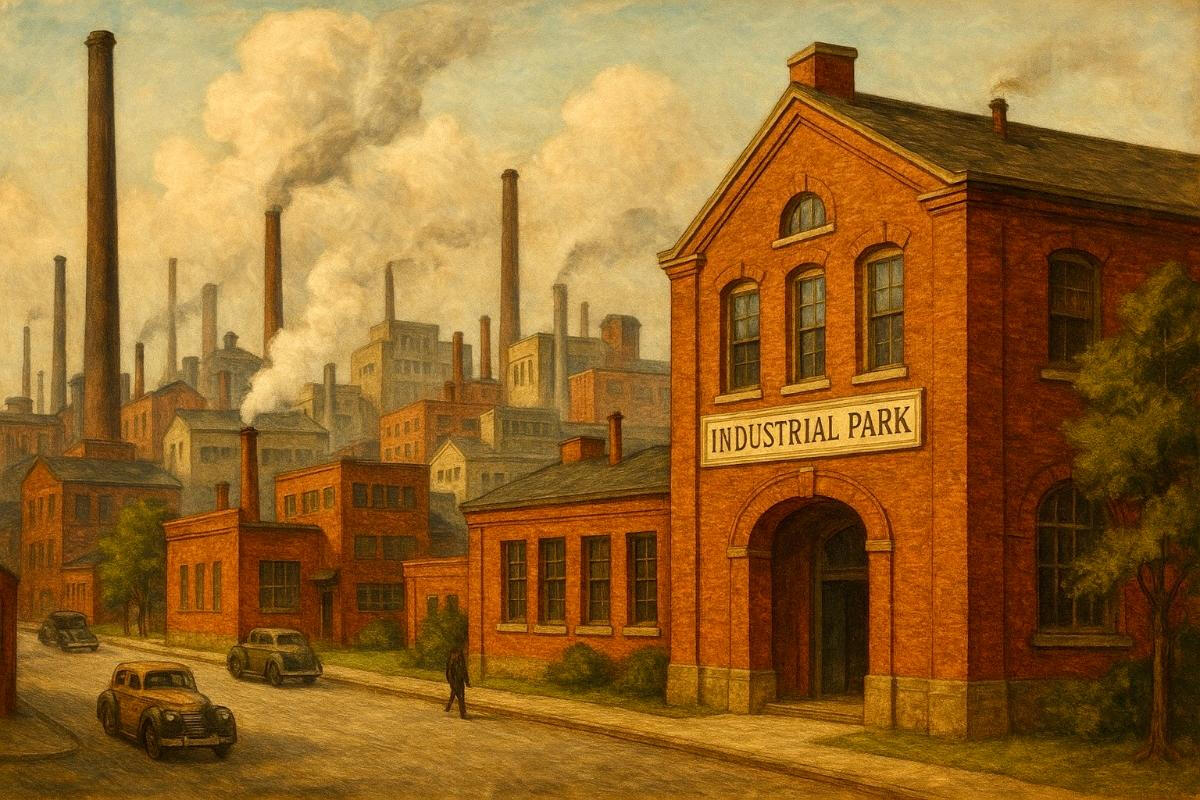
The surest path to higher wages and a stronger Republic lies in directing our national resources toward the work that truly builds wealth—toward the roads that bind our communities, the factories that forge our future, the power that lights our homes, the farms that feed our children, and the machines that magnify the hand of labor.When America invests in production rather than in idle speculation, employment grows, prices find their balance, and the earnings of our people carry them further. Modern equipment, sturdy domestic supply lines, fair and open competition, and a system of credit that is honest, affordable, and loyal to the public good—these are the instruments by which every workshop, mill, and plant may expand without being throttled by the burdens of private greed.America doesn’t need more speculation—it needs more production, more power, more skilled hands, and a credit system that nourishes industry instead of draining it. Build these foundations, and prosperity will follow as surely as daylight follows the dawn.
Build Demand for Labor by Investing in America
Pass a multi-year national infrastructure program: Highways, bridges, water systems, ports, rail, airports, and grid modernization. Long-term authorizations (5–10 years) give contractors & manufacturers certainty to hire & expand.Restore & expand federal industrial credit programs: Reauthorize EXIM Bank, strengthen the DFC for domestic projects, expand DOE Loan Programs Office to cover more manufacturing sectors, or create a new Industrial Finance Authority.Provide targeted tax credits for domestic production: Advanced manufacturing credits, energy production credits, “Made in USA” supply chain credits.Reform permitting (NEPA modernization): Speed up clean energy, transmission, and industrial construction without removing environmental protections.Establish regional manufacturing hubs: Federal matching grants to states to build industrial parks, logistics hubs, and advanced manufacturing zones.These actions directly raise labor demand across construction, logistics, energy, and manufacturing.
Boost Real Wages by Raising Productivity
Create an accelerated depreciation system for small & midsized firms: Let businesses write off machinery, robotics, automation, and energy efficiency upgrades within 1–3 years.Expand NSF/NIH/DOE technology adoption programs: Turn research into real commercial tools for businesses, not just labs & universities.Make reshoring tax incentives permanent: Credits for relocating factories, tool-and-die shops, advanced manufacturing facilities, semiconductor equipment, food processing, etc.Fund vocational & technical centers that partner with real employers: Training matched to actual industry needs → higher productivity → higher wages.Federal investment + business investment = sustained productivity growth → rising paychecks.
Stabilize Prices to Protect Take-Home Pay
Expand energy supply & transmission: Fund grid upgrades, permit new pipelines, increase refinery capacity, and accelerate clean energy approvals.Increase housing construction by reforming zoning incentives: Provide federal incentives to cities & counties that allow more starter homes & multi-family housing.Invest in ports, rail, and trucking modernization: Dedicated freight investments reduce shipping costs—one of the biggest drivers of price spikes.Use targeted fiscal discipline: Cut waste in overheated sectors while maintaining investment in high-multiplier areas (infrastructure, manufacturing, energy).Lower prices = stronger real wages without forcing layoffs.
Increase the Supply of Good Jobs, Not Just Any Jobs
Fund apprenticeship programs tied directly to industry hiring needs: Require employer commitments so trainees walk into real jobs.Expand Buy American and Hire American rules: Ensure federal purchasing creates U.S. jobs instead of subsidizing foreign factories.Create local supply-chain clusters: Federal grants to cities & counties to build industrial parks, training centers, and logistics hubs near each other.Use federal procurement to back U.S. producers: Government purchases over $700B/year—the single largest buyer in America. Use it strategically.Clusters + production incentives = more stable, higher-wage jobs.
Strengthen Worker Bargaining Power
Strengthen antitrust enforcement: Increase funding & authority for DOJ/FTC to break up anti-competitive mergers that depress wages.Clarify protections for gig & contract workers: Prevent misclassification, ensure minimum standards for pay, safety, and benefits.Create portable benefits accounts:
Retirement, healthcare, and leave benefits follow the worker, not the employer—this frees workers to move to better-paying jobs.Ensure fair union elections & prevent retaliation: Without forcing membership, but guaranteeing workers have the right to organize without intimidation.Competitive labor markets lift wages naturally—without heavy handed mandates.
Use Public Credit to Lower Business Costs Without Raising Taxes
Charter a National Industrial Bank or Industrial Credit Authority: Modeled after TVA, EXIM, RFC, or Farm Credit—but focused on domestic production.Authorize 0–2% long-term loans for factories, equipment, energy projects, logistics facilities, and processing plants.Allow states & regions to create matching public-credit banks: The federal institution can guarantee or co-finance state industrial banks.Back the bank with federal bonds, not taxpayer dollars: This keeps taxes low while dramatically lowering the cost of capital for U.S. producers.Require domestic procurement & hiring to receive credit: Ensures public credit builds American jobs—not foreign outsourcing.Cheap credit = more investment = more productivity = higher wages.
Elect
Bernie Reyna
Tuesday, March 3
Paid for by Bernie Reyna for Congress • © 2025 All rights reserved.
Healthcare Costs
Congress can repair healthcare only by dealing with it as one would deal with any system seized by speculators: abolish the monopolies, strip away the parasitic layers of profit, and return the machinery of care to the people who create its real value. The greedy hospital monopolies and insurance combines must be broken up, for they exist not to heal but to extract surplus from human suffering. Their pricing must be laid bare; their power to dictate the terms of life & death must be curtailed.Let Medicare bargain as any collective of workers would — not as a beggar, but as a disciplined purchaser acting on behalf of everyone. Set clear limits on what the working family can be compelled to pay, make every middleman reveal the transactions by which they enrich themselves, and ensure that every rebate & every saving flows back to the people, not to Wall-Street.Extend primary care so that illness is met early, before it becomes a burden of crisis. Guarantee protection against catastrophic costs so no household is thrust into ruin by the misfortune of disease. Sweep away the bureaucratic clutter—the paperwork, the billing games, the administrative labyrinths—which are nothing more than the dead weight of greed upon the living body of society.If Congress restores competition, transparency, and efficiency—not in the service of Wall-Street, but in the service of our Nation—then costs will fall, care will rise, and citizens will stand no longer as crops for exploitation, but as a community capable of healing itself.
Break Hospital & Insurance Monopolies (Competition Reform)
Anti-Monopoly Hospital Reform ActBan anti-competitive hospital mergers (restore the FTC’s pre-merger review power).Require hospitals acquiring physician practices to undergo federal competition review.Mandate competitive bidding for high cost hospital services.Tie federal funding (e.g., Medicare/ Medicaid reimbursements) to compliance with pricing transparency.Price Transparency EnforcementCurrent transparency laws have no teeth.Impose civil penalties for hospitals that hide prices.Require standardized price formats nationwide so consumers can actually compare.Mandate insurer disclosure of negotiated rates in machine readable format.Lower prices through real market competition.
Expand Medicare Drug Price Negotiation
Congress can pass a Medicare Drug Negotiation Expansion Act to:Allow negotiation on all drugs with high national spending, not just 20-30.Extend negotiation to Medicare Advantage, Medicaid, and the VA for consistency.Cap insulin at $35 for everyone (public + private insurance).Prevent drug companies from raising prices faster than inflation.Revenue impact: Saves hundreds of billions over 10 years (CBO-confirmed).Lower premiums + lower drug costs for every American.
Cap Out-of-Pocket Costs & Premium Growth
Universal Out of Pocket Caps: Create a single national annual cap for all insurance types (like Medicare Advantage has).Apply it to ACA plans, employer plans, and Medicare.Premium Growth Caps: Link premium growth to GDP per capita or median income, so insurance cannot outgrow wages.Give regulators power to reject unreasonable rate increases (what states like CA already do).Ban Surprise Billing Expansion.
Strengthen the No Surprises Act by:Closing loopholes used by air ambulances & specialty contractors.Requiring binding arbitration to discourage overbilling.Predictable household budgets and less medical debt.
Regulate PBMs (Pharmacy Middlemen)
Congress can pass a PBM Reform & Transparency Act to: Force PBMs to disclose rebate agreements.Ban spread pricing (PBMs charging insurers more than pharmacies receive).Require PBMs to pass 100% of rebates to consumers or insurers.Prohibit steering patients to PBM owned pharmacies.Empower the FTC to audit PBM contracts.Drug prices drop almost instantly.
Expand Primary & Preventive Care (The Highest ROI in Healthcare)
Community Health ExpansionGrants for community clinics in rural & urban shortage areas.Loan forgiveness programs to attract primary care doctors.
Telehealth Permanency ActMake pandemic-era telehealth expansions permanent across Medicare/Medicaid.Require insurers to reimburse telehealth at fair rates.
Nurse Practitioner Scope ReformIncentivize states (via federal matching funds) to authorize full practice authority for NPs in shortage areas.Earlier care → fewer emergencies → lower premiums.
Universal Catastrophic Coverage
Congress can pass a Catastrophic Protection Act to create:A national catastrophic plan that automatically covers all Americans.A hard annual cap (e.g., $5,000-$10,000) beyond which government coverage kicks in.Private insurance still covers normal care.This delivers universal protection without replacing existing plans.No more medical bankruptcies in America.
Slash Administrative Waste ($200–300B/year savings)
Unified Billing StandardsReplace thousands of billing codes with a unified national standard.Require all insurers to accept the same digital formats.Pre-Authorization ReformSet federal limits on the number of procedures requiring pre-authorization.Impose penalties on insurers that abuse pre-auth delays.National Electronic Health Record (EHR) StandardsRequire interoperability: every provider must use systems that can talk to each other.Federal grants to help small clinics upgrade.Less paperwork → lower premiums → higher doctor productivity.
Elect
Bernie Reyna
Tuesday, March 3
Paid for by Bernie Reyna for Congress • © 2025 All rights reserved.

Affordable Housing
When you’ve got a housing mess, you fix it the same way you’d tackle a stubborn bottleneck on a job site: clear the clutter, keep the materials flowing, and get production back on track.First step: help our towns actually say “yes” to sensible building. Federal support can nudge local rules so builders can put up the kinds of homes folks need.Next: put more carpenters, electricians, plumbers, and tradesmen into the field. You can’t build a house without skilled hands.And while we’re at it, trim down the permitting red tape that brings every project to a crawl.America also needs to rebuild the factories that supply the backbone of construction—lumber, steel, concrete, fixtures, and all the parts that hold a home together. A steady domestic supply keeps costs under control.Then give families a leg up: use tax credits to make starter homes affordable and help working people actually buy them.We’ve also got to keep Wall Street from turning homes into investment chips. Houses are for living in, not gambling on.Finally, remember the basics: lay the pipes, roads, power lines, and transit so new neighborhoods have the infrastructure to grow strong.If Congress treats housing like the essential trade it is—not a playground for speculators—we can build enough solid, affordable homes to give every American a place to call their own.
Fix the Supply Shortage by Incentivizing Zoning Reform
Congress cannot rewrite local zoning, but it can use the federal spending power.Congress can pass a Housing Supply Acceleration Act, that:Ties federal grants (transportation, infrastructure, broadband, water, sewer, HUD funds) to: allowing duplexes/ triplexes/ fourplexes near jobs and transit, reducing minimum lot sizes, permitting starter homes under 1,600 sq ft, setting fast permitting timelines (ex: 90 days)Use conditional funding, the same method used to raise the drinking age, expand highways, and enforce civil-rights compliance.Cities build more housing → prices stabilize and fall over time.
Lower the Cost of Building Through Workforce, Permitting, and Materials
Congress controls federal labor programs, permitting standards, and industrial policy.Construction Workforce Expansion Act:Expand apprenticeships through the Dept. of Labor. Fund community college training for carpentry, electrical, plumbing, HVAC. Create a GI Bill for Trades for young workersNational Model Permitting Code:Congress directs HUD+Commerce to publish model permitting rules.Provide grants to cities that adopt: digital permitting, 90 day approval windows, standardized inspectionsDomestic Building Materials Production Act:Tax credits & loans for U.S. lumber, steel, drywall, concrete, and modular factory expansion. Expand freight/ logistics investments so materials move cheaplyLower costs → more homes built → lower prices.
Expand Affordable Housing & Revive Starter Homes
Congress controls all federal housing finance mechanisms.LIHTC Expansion Act:Increase allocations to all states. Add a starter home category for homes under 1,600 sq ft. Prioritize mixed income development.Starter Home Tax Credit (New Deal for Housing Act):Tax credits for developers who build: small single-family homes, townhomes, duplexes/ fourplexes, modular/ manufactured homes.Bonus credits for homes priced under local median.Public-Private Partnership Accelerator:Federal seed capital for mixed income projects. Local match required (ensures skin in the game)Affordable units actually get built; starter homes return to the market.
Support First-Time Buyers & Renters
Congress controls federal tax credits & HUD rental programs.First Time Homebuyer Refundable Credit:Modeled after the 2008-2010 version, but better targeted. Helps moderate income families build equity.Expansion of Housing Choice Vouchers:Increase funding. Require source of income protections. Increase mobility counseling to help families move to good school districts.Targeted Rent Relief:A federal emergency rent stabilization fund for high cost metros. Prevents eviction spikes during price surges.Families access stable housing without distorting overall supply.
Restrict Corporate Speculation in Single-Family Homes
Congress can regulate financial markets & interstate investment.Anti-Bulk Buying Act:Prevent private equity firms from purchasing large bundles of single family homes.Cap the number of homes any institutional investor can own per metro area.Anti-Speculative Flipping Penalty:A federal excise tax on homes resold within 6-12 months.Exemptions for veterans, first-time buyers, and owner occupants.Ownership Transparency Requirements:Mandatory disclosure of beneficial owners buying single family homesMore homes available for families, less for corporate extraction.
Build the Infrastructure Needed for Housing Supply
Congress controls infrastructure spending & loan programs.Housing Linked Infrastructure Grants:Federal matching funds for water, sewer, roads, drainage, power, broadband.Prioritize projects tied to new housing construction.National Infrastructure Bank (NIB):Offers long term, low interest loans to cities for: utilities, road expansions, stormwater systems, transit access projects.Fast Track Infrastructure Permitting:Streamlined NEPA reviews for housing linked infrastructure.Housing can be built where it’s needed, not only where infrastructure already exists.
Build Near Jobs, Transit, and Schools
Congress controls all federal transit & education construction funds.Transit Oriented Development Fund:Tie federal transit dollars to guaranteed housing production near stops.Require zoning for mixed use walkable districts.School Housing Coordination Grants:Encourage districts to plan school expansions alongside new housing.Lower long term costs for commuting families.More walkable neighborhoods, lower transport costs, healthier local economies.
Elect
Bernie Reyna
Tuesday, March 3
Paid for by Bernie Reyna for Congress • © 2025 All rights reserved.
Economic Fairness
Congress can lift wages and strengthen the nation by doing what any successful industry does: invest in real work, clear out the bottlenecks, and give every man & woman the tools to rise.Build the roads, bridges, plants, and power lines.Supply cheap, honest credit to industry.Train the next generation of craftsmen.Clear the red tape that slows production.Give workers a fair shake by enforcing honest labor practices, cutting out wage theft, and stopping tricks that bind a worker to his boss.Lower the costs of living—housing, healthcare, childcare, energy—so a paycheck actually means something.Make sure the rich pay what they owe.Keep the safety net firm without dulling ambition.Help families build savings & homes of their own.If Congress puts production, fairness, and efficiency ahead of speculation & loopholes, America’s workers will thrive, and the whole country will move forward as one.
Increase Wages by Restoring Labor Demand
Congress has direct levers over national investment, permitting, and industrial capacity. To raise labor demand, Congress can:Pass a multi-year national infrastructure program:Highways, bridges, ports, rail, airports, water systems, broadband, and grid modernization.Long term authorizations (5-10 years) give firms confidence to hire & invest.Create or expand federal industrial finance tools. Congress can:Expand the DOE Loan Programs Office for manufacturing.Strengthen the Development Finance Corporation for domestic industry.Reauthorize & enlarge the Export Import Bank.Establish a new National Industrial Bank or Industrial Finance Authority.These provide low cost capital for factories, energy, logistics, and advanced manufacturing.Modernize federal permitting:NEPA streamlining, faster environmental reviews, predictable timelines for energy, transmission, and industrial projects.Expand apprenticeships & workforce training:Fund Dept. of Labor apprenticeship grants, community college partnerships, and employer led training consortia.
Strengthen Worker Bargaining Power
Congress directly controls national labor law.Modernize the National Labor Relations Act: Ensure fair, secret ballot union elections; prohibit coercion or retaliation by any party; and protect lawful organizing activity.Ban abusive non-compete clauses nationally to promote competition, worker mobility, and wage growth.Crack down on wage theft: Increase federal penalties & enforcement capacity within the Department of Labor.Clarify worker classification standards to protect genuinely misclassified workers while preserving legitimate independent contracting.Raise the federal minimum wage gradually: Tie increases to productivity or regional cost of living.Expand the Earned Income Tax Credit (EITC): Boost take home pay for low & moderate income workers without harming job creation.
Expand Access to Education, Skills & Upward Mobility
Congress sets federal education funding and workforce policy.Universal early childhood education: Offer optional universal pre-K through federal grants to states.Tuition-free or low cost community college: A federal state matching program to eliminate tuition for 2 year degrees & technical certifications.Employer linked training pipelines: Congress can fund workforce partnerships that connect local employers to community colleges & apprenticeships.National Apprenticeship Expansion Act: Scale up apprenticeships in construction, advanced manufacturing, clean energy, and the trades.
Lower the Cost of Essentials
Essential costs determine real inequality. Congress can act in each sector.Housing: Tie federal infrastructure grants to zoning reform. Expand Low Income Housing Tax Credit (LIHTC). Increase funding for HUD construction programs. Incentivize starter home development under 1,600 sq ft.Healthcare: Expand price negotiation authority. Enforce hospital & insurer price transparency. Promote competition in pharmaceuticals & insurance markets.Childcare: Increase childcare tax credits. Expand subsidies tied to income. Support childcare workforce training & facility construction.Energy: Accelerate grid construction & modernization. Expand domestic production of energy & critical minerals. Offer incentives for home efficiency upgradesTransportation: Expand public transit capital grants. Modernize highways & supply chain logistics corridors.
Ensure the Wealthy Pay a Fair Share Without Hurting Growth
Congress writes the tax code, and the most effective tools for reducing inequality and strengthening growth fall squarely within its constitutional authority.Close major loopholes: End carried interest, eliminate offshore profit shifting shelters, and limit abuse of stepped up basis that allows permanent tax avoidance by billionaires.Corporate minimum tax: Ensure large corporations pay a minimum effective rate regardless of deductions, while preserving incentives for real investment.Billionaire minimum income tax: Ensure very high income individuals pay a minimum effective tax on realized income by ending special financial strategies that allow indefinite deferral, while protecting productive investment & retirement savings.Enforcement: Fully fund the IRS to focus enforcement on high income & high wealth tax evasion, not working families.Simplification: Reduce carveouts and special preferences that distort economic behavior and reward tax engineering over productive work.
Strengthen the Social Safety Net Without Discouraging Work
Congress controls every major safety net program.Restore the Child Tax Credit expansion: Reduce child poverty, increase family stability.Expand EITC: Reward work & increase take home pay.Modernize SNAP: Raise benefits modestly to reflect real food prices & reduce administrative burdens.Smooth benefit phase outs: Eliminate benefit cliffs that punish work increases.Federal paid family & medical leave: A national paid leave standard increases labor force participation.
Build Wealth for Working Families
Income inequality becomes permanent when families cannot build wealth.Automatic retirement accounts (opt out): Modeled on Thrift Savings Plan; workers contribute automatically unless they choose not to.Down payment assistance for first generation homebuyers: Helps families break the no wealth → no homeownership cycle.Baby bonds: Small, federally seeded trust accounts that grow until adulthood.Government backed savings programs: Matched savings for low & moderate income households.
Elect
Bernie Reyna
Tuesday, March 3


Paid for by Bernie Reyna for Congress • © 2025 All rights reserved.
Guarding the Republic From Foreign Influence
America’s free and democratic process rests upon the sovereignty of her people, and it cannot endure if any foreign nation (whether ally or adversary) is permitted to pour vast sums of money into the channels of our political life.When we allow outside interests to shape our elections, we surrender—quietly, perhaps unknowingly—a measure of our own independence. We permit others to place their hand upon the scales of our self-government, and we risk the slow erosion of the very liberties that generations of Americans have struggled to secure.History reminds us that freedom seldom disappears in a single stroke; it is often bartered away, inch by inch.A century ago, China learned this lesson when foreign powers, through influence, pressure, and financial entanglement, gained control of her ports, her courts, and her commerce. Those treaty ports were not taken by sudden force, they were conceded over time, as outside governments insinuated themselves into the affairs of a sovereign nation, until the line between independence and subservience had all but vanished.America must not—and will not—repeat that mistake.When foreign actors seek to sway the decisions of our elected leaders, they do more than influence policy; they diminish the sacred right of every American to determine the course of his own country. And when representatives fear the power of foreign policy financiers more than the judgment of their own constituents, our Republic is no longer guided by the will of the people but by pressures that have no rightful place in a free society.Our foreign policy, our domestic policy, our destiny as a nation must be shaped by one sovereign authority: the citizens of the United States.No foreign treasury, no outside lobby, and no international pressure group can be permitted to decide who speaks for Texas or for America. For in the final analysis, the strength of our Republic rests upon this unshakable truth: the only rightful masters of American policy are the American people themselves.Any force—foreign or domestic—that seeks to overrule their voice strikes at the very foundation of our freedom.
Elect
Bernie Reyna
Tuesday, March 3


Paid for by Bernie Reyna for Congress • © 2025 All rights reserved.
Immigration

1). Protect Dreamers
-Permanent legal status and a clear path to citizenship for DACA recipients.
-No more temporary extensions — full certainty under law.2). Keep Families Together
-End family separation policies permanently.
-Expand humanitarian parole and family reunification visas.
-Speed up processing for spouses & children of U.S. citizens.3). Regulate ICE & End Abuse
-Independent oversight board with subpoena power.
-No masks, and visible badge numbers.
-Body cameras and public reporting requirements.
-Clear use-of-force standards.
-Shift focus to violent criminals(not long settled families).4). Shut Down For-Profit Detention Centers
-End federal contracts with private prison corporations.
-Replace prolonged detention with supervised release + case management.
-Prioritize alternatives to detention for families & asylum seekers.5). Expand Green Cards
-Recapture unused green cards from previous years.
-Clear family and employment based backlogs.
-Reduce processing times to under 12 months.6). Oppose Corporate Visa Abuse
-Reform or suspend H-1B visas where they are used to undercut American wages.
-Require strict prevailing wage enforcement.
-End outsourcing loopholes and labor substitution practices.7). End Mass Deportation Proposals
-No large scale removal of long settled, non-violent residents.
-Focus enforcement resources on traffickers and violent offenders.8). Oppose Expanding a Wall Across Remote Desert
-Billions spent on fencing in empty terrain with minimal traffic.
-Environmental damage and eminent domain fights with Texas landowners.
-Cartels adapt with tunnels, ladders, drones, and ports-of-entry smuggling.9). Prioritize Ports of Entry
-Most fentanyl and high value trafficking move through legal crossings.
-Invest in scanners, detection tech, and staffing.10). Hit the Smuggling Networks
-Target cartel logistics, financial flows, and human trafficking rings.
-Expand joint federal–state task forces.

Engineers know: sometimes a machine needs pressure to get moving.
Open the valve slightly—pressure rises—everything runs smoothly.
Open it too fast and you burst the system.
Close it too tightly and the machine stalls.Immigration works the same way:
a steady hand on the valve, opening & closing gradually, guided by the gauges of employment, wages, and national demand.That is smart policy. That is how you protect American workers and American prosperity.
Immigration should not be administered as a legal proceeding
The Department of Justice is designed to adjudicate violations of law, not to manage production functions, labor inputs, or industry capacity. Legal tools cannot increase output any more than litigation can raise dairy yields or police tactics can repair household infrastructure. A courtroom cannot substitute for an economic institution.
Checks & Balances, break Immigration up
Immigration is fundamentally a labor market mechanism, and should therefore be governed by the agencies responsible for production & employment:the Department of Commerce
the Department of Labor.Commerce represents the demand side of the labor market: industries requiring additional workers to maintain output, reduce bottlenecks, or expand capacity.Labor represents the supply side constraints: wage levels, unemployment, underemployment, and the need to protect domestic workers from downward pressure.
Operate Immigration like a Business, not a Courtroom Drama
In economics, stable systems arise when supply & demand are balanced through transparent rules and measurable indicators, not legal improvisation.Under a market based regulatory framework:Commerce would initiate requests for additional labor inflows when firms face capacity shortages or persistent vacancies relative to production requirements.Labor would evaluate & approve those requests only when macroeconomic indicators—unemployment rates, labor force participation, wage growth, and sector specific tightness—justify an adjustment in labor supply.This system functions as a labor market stabilizer: expanding supply when the economy overheats, tightening supply when labor markets soften.That is how you create predictable, countercyclical, data driven immigration policy—one that protects American workers, supports American industries, and keeps the broader economy in equilibrium.
Biden's mistake
At the same time, we have to level with the American people: the Biden Administration made a real mistake by allowing too many unvetted immigrants into our country all at once. But in America, we don’t correct one error by committing a greater one. We don’t answer government missteps with violence, cruelty, or the dark temptations of Fascism. This nation has always solved its challenges the same way—through checks & balances, through calm & steady leadership, and through a basic civic decency that reflects the best of our character.
Loyalty not Amnesty
Citizenship is precious and should never be undermined. It is a sacred trust in a self governing republic. But we cannot guard it too jealously denying others a sweet taste of the good life that America has offered generation after generation.There must be a standard. There must be a path. There must be a test of loyalty.If an immigrant has worked peacefully & productively in the United States for 18 years—with no crimes committed—they have demonstrated commitment, integration, and patience.We demand that our own children wait 18 years before casting their first vote.Eighteen years is a fair, equitable measure of dedication for those who have built a life here.A nation can be both strong & welcoming.
Firm in its laws & generous in its spirit.
Protective of its borders & proud of the people who cross them legally.That is the balance America deserves.
That is the balance I will fight for.
Elect
Bernie Reyna
Tuesday, March 3
Paid for by Bernie Reyna for Congress • © 2025 All rights reserved.
Protecting Mothers, Babies, and Families
I am moderately pro-life, but I do not believe women should be abandoned in crisis.
Immediate protections:
-Protect doctors and women in medical emergencies-Prioritize the life & health of the mother
Pro-mother/child support:
-Expand prenatal, postpartum, and maternal healthcare-Support for infants, children, and families after birth-Universal access to contraception
-Strengthen SNAP and maternal nutrition support-Paid family leave and workplace protections for parents-Universal childcare-Affordable housing and anti-poverty support for mothers and children
Legal boundary:
-I oppose codifying Roe v. Wade-I oppose federal funding for abortion.
State level access protections:
-Protect interstate travel for pro-choice care
-Protect mifepristone-misoprostol regimen in pro-choice states
-Protect telemedicine access in pro-choice states
-Protect Texas’s democratic right to follow the Supreme Court and choose its own path (whether more pro-life or more pro-choice) without federal interference.
Life & Reproductive Ethics
I speak first as a Roman Catholic, for before I am a public servant, I am a soul under God. The faith of the Church teaches us that every human life bears the imprint of the divine, and thus must be treated with reverence. The Church cannot bless abortion, and I take that teaching not as a burden, but as a light by which I walk.Yet public life requires us to meet people where they truly are—in their fears, their struggles, and the tangled circumstances of a fallen world. Moral truth does not exempt us from compassion; rather, it commands it.It is in that spirit that I support confidential, affordable access to contraception for every woman who needs it—medications that work by preventing ovulation and fertilization before a pregnancy begins. In those earliest hours, before conception has occurred, we can act to prevent heartache while honoring the dignity of life. That is both responsible & compassionate.
Responsibility With Charity
But let me be clear: whenever a society imposes limits upon a woman's choices, it assumes a grave responsibility. If we ask her to carry the weight of motherhood, then we must not leave her to bear it alone.Responsibility without charity is a Pharisee’s bargain.Therefore, justice demands that we provide:Healthcare worthy of both mother & child,Time & protection in the workplace for those who give life,Childcare & housing that lift burdens rather than add to them,The nourishment & medical care that human dignity requires,And pathways not into poverty, but out of it.
Real Support for Mothers & Children
No woman should sink into poverty because she has welcomed a child. No child should enter the world only to find society indifferent to his or her future. To honor life is to cradle it not only in the womb, but in the world.My position is rooted in faith, in compassion, and in a profound sense of duty: the defense of life must never end at birth, nor can moral conviction stand without social responsibility. It is not enough to command; we must also accompany. It is not enough to speak of life; we must sustain it.
Elect
Bernie Reyna
Tuesday, March 3
Paid for by Bernie Reyna for Congress • © 2025 All rights reserved.
Liberty’s Structural Defense
1). Arms belong to the people—not the state.2). The right to keep and bear arms exists prior to the Constitution.3). The Second Amendment did not grant a right—it reaffirmed one.4). Its purpose is defense: personal & collective.5). The default condition of a free society is an armed citizenry.6). Disarmament is exceptional—limited to criminals or those who pose a demonstrable danger.7). The right belongs to peaceable citizens, not criminals or insurrectionists.8). The federal government was never meant to control this right.9). The Amendment exists to make that boundary unambiguous.
Liberty Requires Capacity
1). Rights without the means of defense are paper promises.2). Liberty is not preserved by words—it is preserved by a people capable of defending it.3). Safety purchased by surrendering that capacity is a mirage.4). A people who cannot resist cannot remain free.5). Disarmament is not reform—it is subjugation.6). A people who surrender their capacity for force surrender their sovereignty.
The Militia Is the People
1). The militia is the people.2). Arms must be held by “the whole body of the people,” not a select class.3). Citizens keep their own arms.4). Training & possession are civic duties, not privileges.5). Local communities—not a distant capital—control defense.6). The militia remains rooted in the citizenry and the states, not federal control.7). The states, backed by armed citizens, form a structural check on federal overreach.8). Tyranny becomes mathematically improbable.
Power, Force, and Accountability
1). Force is the ultimate political power.2). Power gravitates toward whoever controls force.3). If government monopolizes force, liberty is conditional.4). If the people retain force, government remains accountable.5). A standing army answers to power.6). A militia answers to the people.7). A republic remains free only while force is ultimately rooted in the people.8). A republic that monopolizes force in government hands ceases to be a republic.
The American Design
1). European rulers fear their own people and disarm them.2). America exists because the people bore arms.3). American government is backed by an armed citizenry and divided power.4). British tyranny began with searches, seizures, and disarmament.5). American liberty required the opposite: a people who retained their arms.6). Government exists to secure that condition—not reverse it.7). The Second Amendment prevents “creative” federal interpretations that would disarm the people.8). It keeps defense local, power diffused, and liberty real.
What This Means
1). The right to arms belongs to individual citizens.2). It serves both private defense and public security.3). It prevents government from monopolizing force.4). Liberty was won by armed citizens.5). It is preserved only by citizens who remain capable of defense.6). Freedom of conscience.7). Trial by jury.8). Protection against general warrants.9). And the right of the people to keep and bear arms.These are not abstractions. They are the architecture of a free republic.
Contact

E-mail
vote4bernie@
tx10bernie.com
Elect
Bernie Reyna
Tuesday, March 3


Paid for by Bernie Reyna for Congress • © 2025 All rights reserved.
Donate

LEGAL NOTICE / CONTRIBUTION RULES
PAID FOR BY Bernie Reyna for Congress.Federal law requires political committees to include a disclaimer on their websites and internet applications and, for authorized committees, to state that the communication has been paid for by the authorized political committee. (11 CFR 110.11.)BEST EFFORTS / REQUIRED DONOR INFORMATION
Federal law requires us to use our best efforts to collect and report the name, mailing address, occupation, and name of employer of individuals whose contributions exceed $200 in an election cycle. Please provide this information when donating.LIMITS AND DESIGNATION
An individual may contribute up to $3,500 per election (primary and general are separate elections). Contributions are subject to the limits and prohibitions of federal law. If you designate your contribution for a specific election (e.g., “Primary” or “General”), it will be applied as designated; if undesignated, it will be applied to the next election in which the candidate participates.PROHIBITED SOURCES
We do not accept contributions from:
• Corporations (including nonprofit corporations) or labor organizations (including union treasury funds);
• Federal government contractors;
• Foreign nationals;
• Contributions made in the name of another person (including reimbursed or “straw donor” contributions).PAYMENT / SOURCE OF FUNDS CERTIFICATION
By donating, you certify that:
• This contribution is made from your own personal funds, and is not being provided to you by another person or entity for the purpose of making this contribution;
• You are using your own personal credit/debit card and not a corporate or business card or a card issued to another person;
• You are a U.S. citizen or lawfully admitted permanent resident (green card holder).ACTBLUE (IF APPLICABLE)
If your contribution is processed through ActBlue, ActBlue requires that a U.S. citizen or permanent resident living abroad donate from within the United States.TAX DEDUCTIBILITY (IRS NOTICE)
Contributions are not deductible for federal income tax purposes. Political committees whose gross annual receipts normally exceed $100,000 are required to include a non-deductibility notice on solicitations.
Elect
Bernie Reyna
Tuesday, March 3


Paid for by Bernie Reyna for Congress • © 2025 All rights reserved.